Negotiation Gate
English audio
Read transcript
Ask where the choice matters
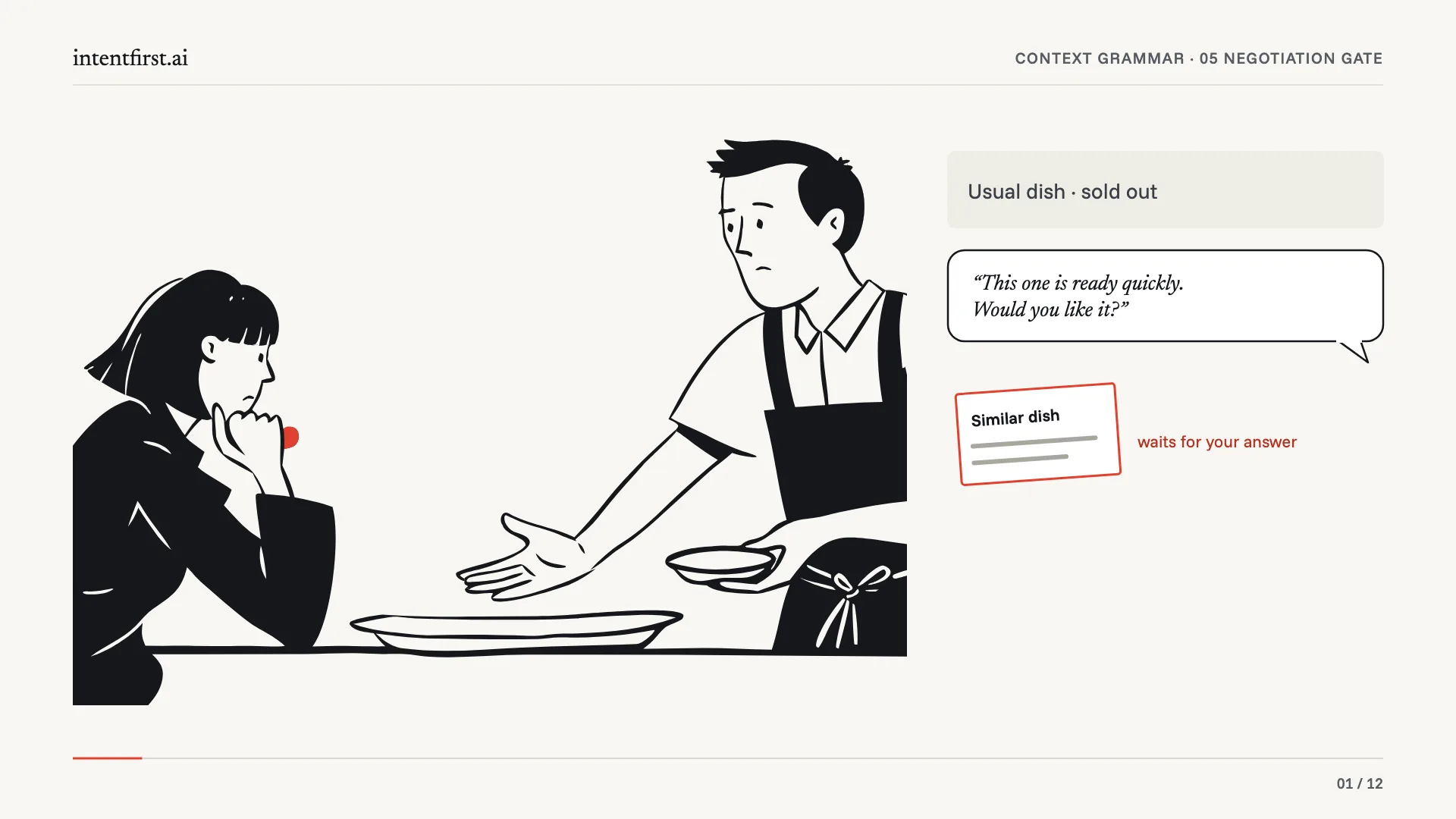
You ask for your usual dish, but it is sold out. The host knows your taste and offers something similar: “This one will be ready quickly. Would you like it?” That brief question catches the part you have not agreed on yet. AI needs to recognize those moments too. The Negotiation Gate decides when an action can proceed and when a conversation is needed.
Check the action, not just the request
“I’m tired today.” A short look at tomorrow’s schedule might help. Canceling your morning meeting on that basis is another matter. The Gate considers each proposed action, not just the sentence that prompted it. Showing a schedule, suggesting a break, and changing a meeting have different consequences and need different levels of checking.
Confidence · Have I understood you?
When planning a trip, someone says, “Somewhere close would be good.” Close to home, or close to the station? Confidence describes how sure the assistant is about its interpretation. One question, “Do you mean a short walk from the station?” can prevent an entire itinerary being built around the wrong assumption.
Risk · What happens if this is wrong?
Showing hotel options is easy to recover from: you can choose different ones. Making an expensive booking commits money and affects the family’s plans. Risk looks at the consequences of getting this particular action wrong. Even with a familiar assistant, the amount involved and the effects on other people can make this a moment to check.
Reversibility · Can we really undo it?
Two bookings at the same hotel can have very different terms. One may be refundable until the day before; another may be final as soon as you pay. Reversibility asks what can really be undone. The same applies to messages: a draft is editable, but you cannot make someone forget what they have read. Check the terms and the remaining effects.
Sensitivity · Does this need particular care?
An assistant may know about a family member’s health when choosing a restaurant. That does not mean a friend traveling with them needs the explanation. Sensitivity concerns information that calls for particular care, including health, finances, and relationships. Even useful information should reach only the appropriate people, at the level they are allowed to see.
Show the understanding. Let the person adjust it.
There are useful ways to ask. An Interpretation Preview says, “I’ve understood that you want less travel.” Assumption Cards show a detail you can correct: “I assumed the walk from the station was manageable.” A Priority Toggle asks whether price or proximity matters more this time. Each helps fix the underlying misunderstanding, rather than asking for a simple yes or no.
Catch the mismatch before the meeting
“Two o’clock at the station.” You both agree, picturing different entrances. With permission to compare those meeting details, the assistants can flag the mismatch: “You have different entrances. Which one should we use?” A useful check does more than protect against an AI mistake. It can help people resolve an ordinary misunderstanding before it becomes a frustrating afternoon.
Why we are asking / What happens next
Before booking, the assistant says, “This fare is nonrefundable. Please review the details.” It keeps a record of the concern and the decision to ask. The technical names are Risk Profile and Gate Decision. If you require approval every time, that stays in force. If you usually delegate but this action needs extra checking, the assistant pauses for that check.
Ask for the reason that matters
Ask before pursuing a new possibility the person has not yet chosen. Check sensitive matters and consequential actions that are hard to undo. When the meaning is unclear, ask a focused question; after a previous misunderstanding, check sooner. The page’s rules R34 through R41 organize these responses. High confidence alone never settles every other concern.
Proceed / Preview / Ask / Block
A request for a five-minute timer does not need a long approval process. It is directly requested, low impact, and easy to stop. Proceed, Preview, Ask, and Block describe different responses: carry on, show the interpretation, ask a question, or stop when the action is not allowed. The aim is an appropriate interaction, rather than a confirmation box for everything.
A small conversation. A better outcome.
Once the host checks the replacement dish, you can relax and enjoy the meal. A good AI interaction can feel just as straightforward. Have we understood the aim? What are the consequences? Can it be undone? Does it involve something sensitive? Check what matters, then continue in the way the person has agreed to. That is the Gate’s job.