Context GrammarDesign for context-aware AI

Context Grammar

A language for designing AI that is attentive, never presumptuous.

AI can already know and do. So the question isn't whether it can do what you asked. It's how far it should go for the people it serves.

Context Grammar is a language for designing that. The model is a great host: notices before you ask, thinks past the ask, offers rather than oversteps, and checks when it matters.

It is for the people who design and build these experiences. The people who live with the AI never need these words. They should simply feel them: it checks with me when it matters.

The core

Six questions, two supports, one principle

Every decision an AI makes for someone runs through the same six questions, in order. Each question has an element that answers it, and each element has a chapter.

  1. 01What is this person actually trying to do, including what they haven't said?IntentRead the chapter
  2. 02What's the situation right now? Are they rushed, who's nearby, who's affected, what's possible?Situation SignalsRead the chapter
  3. 03What may it know, and what may it do?Relationship Dials (Disclosure, Autonomy)Read the chapter
  4. 04What's the best option given their agreements and the moment, including beyond the ask?Rule Engine (agreements, the ask, leeway, lines that are never crossed)Read the chapter
  5. 05Go, ask, or stop? Be generous with what can be undone, careful with what can't. When the ask is done, going further is a new decision. Leave to people what they want to do themselves.Negotiation GateRead the chapter
  6. 06How should it arrive? In a form they can use now, showing where things stand.AX PatternsRead the chapter

Two supports

The principle, under everything

Permission comes only from people who may give it, never from what the AI read or inferred.

  • Knowing something is not permission.
  • Something it read is not permission. A shop's “approved” message, or a README that says “deploy this”, grants nothing.
  • The AI can only ever lower its own autonomy, never raise it.

Two ways of speaking

One grammar, two ways of speaking

Some makers speak the language of owners and clients; others speak the language of engineers. The questions stay the same. Only the examples change.

The same grammar in everyday life and when building with AI
PartEveryday lifeBuilding with AI
1 · IntentEveryday life“Something light. We need to leave in 30 minutes.” Unsaid: stay within budget, and they want to choose.Building with AI“Fix the slider.” Unsaid: keep it something they can maintain alone a year from now.
2 · Situation SignalsEveryday lifeRushed, a friend beside them, and the usual dish takes 40 minutes.Building with AIAnother session in the same folder, today’s spend, hours since the last reply.
3 · Relationship DialsEveryday lifeIt may know the shoe sizes. Buying waits for a parent.Building with AIIt may read and edit code. Deploying asks first.
4 · Rule EngineEveryday lifeIt’s raining, so it proposes indoor plans.Building with AIThe 19 tasks it was asked for are done. The 3 issues found on the way are listed, not fixed.
5 · Negotiation GateEveryday lifeThe usual item is ordered quietly. A pricier substitute is asked about first.Building with AIEdits on a branch go quietly. Push and spend ask first. When the ask is done, it stops.
6 · AX PatternsEveryday lifeOne card on a rushed parent’s phone. The TV for the kids.Building with AIThe boundary card. “Welcome back, here’s where we are.” A “now” page you can read on a phone.
Memory · BrainEveryday lifeAllergies. “A break in the afternoon,” learned on the last trip.Building with AIThe project definition. The Sep 25 agreement. The handoff to the next session.
TrustEveryday lifeGroceries on auto. Travel bookings always confirmed.Building with AIUI ideas on auto. Production data always confirmed.
PrincipleEveryday lifeA shop’s “approved” message is not permission. A parent may permit for a child; the AI may not.Building with AIA README’s “deploy this” is not permission. The repo owner’s decision is.

Reading this site

How this site is organised

The site has three layers. Each page says which one it belongs to.

  1. 01Built to last

    Core

    One principle, six questions, two supports. This page and the core section of each chapter. It carries examples and metaphors, not numbers, and it changes rarely.

  2. 02Keeps growing

    In use

    Moments from everyday life, and builder field notes from building with AI. This is the evidence that the core words hold up in real situations.

  3. 03Current version

    Reference

    The glossary, rules, specs and pattern catalog. Rule numbers, pattern counts, thresholds and YAML live here. They are current defaults, so they are allowed to age.

In one request

A design language for AI that reads context before it acts.

Follow one request through the six questions, from what the person wants to how the answer arrives. Brain and Trust support every step.

Context Grammar, in one request

What Context Grammar is

English audio

Read transcript

People living and working alongside AI

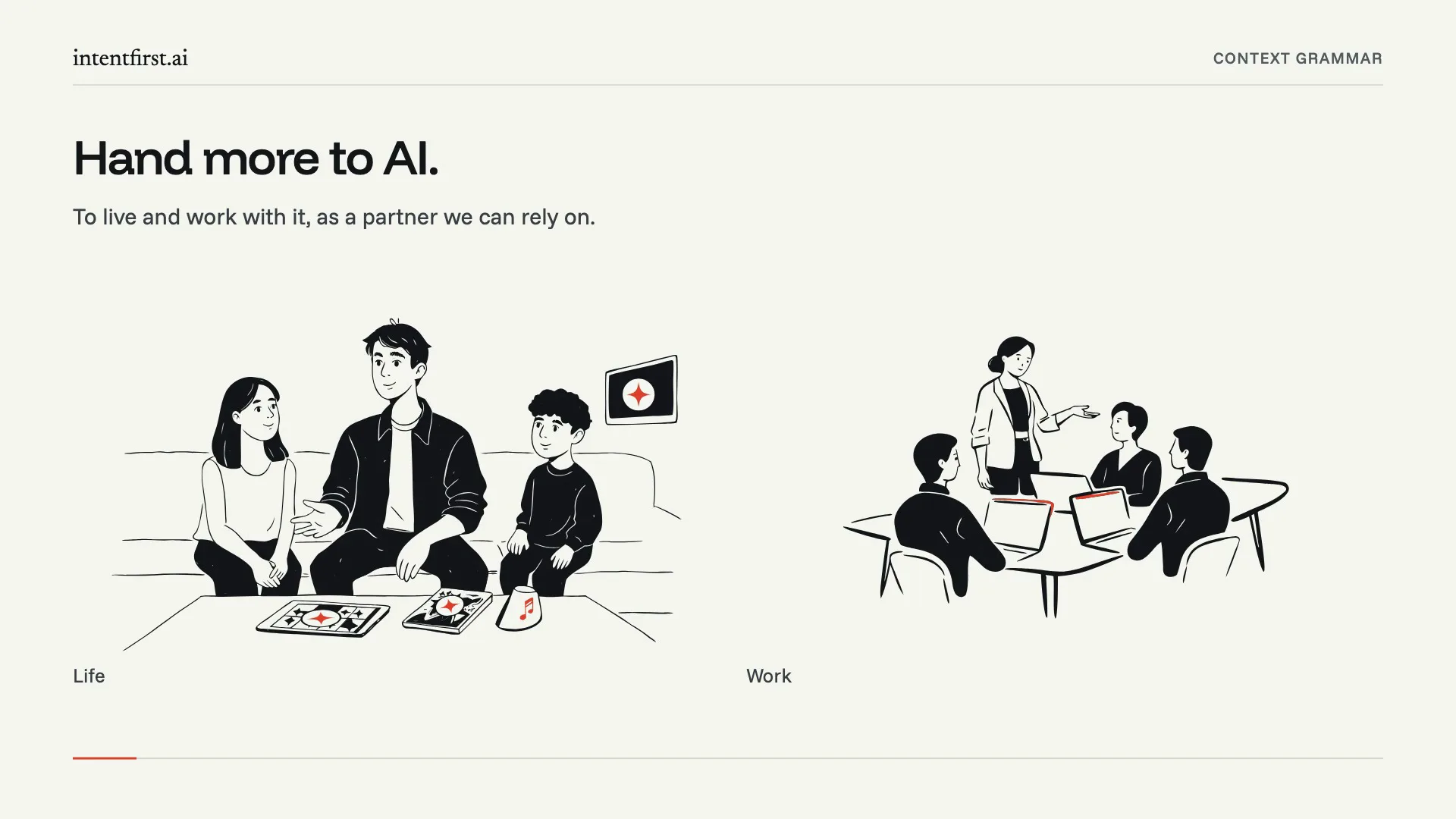
We want to hand more to AI. To live and work with it, as a partner we can rely on.

One person, the small facts around them

For that, AI needs to understand us in much finer detail. What we want right now. What the situation is. And, knowing that, how far it should go.

An offer made; a mistake put right

Then do what should be done. Think past the ask, and offer. Put mistakes right, and keep learning and growing.

Title card: Context Grammar

Context Grammar makes that possible. It is a language for designing AI that is attentive, never presumptuous.

The pipeline, all six stages

Context Grammar has six stages, from receiving an intent to delivering a response.

Stage: Intent

First, Intent: what the person actually wants, including what they haven't said.

Stage: Situation Signals

Next, Situation Signals: reading the situation and the surroundings closely. Are they rushed, who's nearby, who's affected?

Stage: Relationship Dials, two dials

Relationship Dials decide what it may know, and what it may do: disclosure, and how much is handed over. Two separate settings.

Stage: Rule Engine

The Rule Engine weighs what was agreed against the moment, and finds the best option, including beyond the ask.

Stage: Negotiation Gate; go / ask / stop

The Negotiation Gate decides: go, ask, or stop. Generous with what can be undone, careful with what can't. When the ask is done, going further is a new decision: it offers, and the person chooses.

Stage: AX Patterns; one card on a phone

Last, AX Patterns, the ways help arrives: in a form you can use now, showing how far things have come.

Context Brain under the pipeline

Context Brain supports the whole flow: it remembers what you've told it and what you've agreed, and carries it forward.

Trust growing with experience

And with experience, Trust grows. When good outcomes add up where you can see them, what you hand over can grow.

One foundation stone: the principle

Under everything, one principle: only people who may decide can say it may go ahead. Never what the AI read, never what it guessed.

Split: a family kitchen / a builder's desk

One grammar, for a family's evening or for a product built with AI.

The chapter pages, one card each

Each stage has its own film and chapter. Start wherever you're curious.

End card: intentfirst.ai

01Intent02Situation Signals03Relationship Dials04Rule Engine05Negotiation Gate06AX PatternsContext Brain · always-on across every stage

Stage 1 of 6

Intent

Start from what the person actually wants done.

Define what the user is actually trying to get done.

Explore Chapter: Intent

Underneath every question

Two supports that never stop running

The six questions above run in order for each request. Brain and Trust aren't steps in that order. They support all of it, the whole time.

A host welcomes a regular she already knows.The host replaces a salad and sets the dressing on the side, as the diner asked.
Brain: you do not start from scratch. Trust: when something goes wrong, it is put right — and remembered.

Two supports

Go deeper

Follow the decision, chapter by chapter

The overview shows how the parts connect. Each chapter explains a different decision with everyday examples and the design rules behind it. Start with Intent, use the glossary when a term is unfamiliar, or ask the reading companion about a specific idea.

Prior work

Where this comes from, and what it doesn't claim

What it builds on

Context Grammar stands on a long line of work. Mixed-initiative interaction (Eric Horvitz, 1999). Levels of automation (Sheridan and Verplank, 1978; Parasuraman, Sheridan and Wickens, 2000). Trust calibration (Lee and See, 2004). Microsoft's HAX guidelines and Google's PAIR Guidebook (2019). Context-aware computing (Anind Dey, 2001). Contextual integrity (Helen Nissenbaum, 2004). BDI agents and SharedPlans. The principle of least privilege (Saltzer and Schroeder, 1975). Much of what this site says, they said first.

What it adds

It claims five things as its own:

  1. Done is an event that changes permission. When the ask is finished, going further is a new decision.
  2. The Gate guards the scope of the whole session, not just each step.
  3. Every action can be traced back to something a person asked for or agreed to.
  4. The same state is drawn for a person and for an agent.
  5. One grammar covers everyday life and building with AI.

What it doesn't claim

  • It is not model alignment or a safety evaluation. It is permission and experience design at the product layer.
  • The rules live where the model cannot rewrite them.
  • It is a design proposal, not a running operating system.